
Guide to Lettings: With Renters Rights Act updates
Church & Hawes have updated our Guide to Lettings incorporating important updates which form part of the Renters Rights Act.
VERY IMPORTANT!!
PLEASE SEE RRA 1.— RRA 11. ON PAGES 20—23
REGARDING RENTERS RIGHTS ACT 2025
CHANGES IN LEGISLATION.
PLEASE NOTE IN RED * (PHASE 1) ARE COMING INTO FORCE ON 1ST MAY 2026 AND IN BLUE (PHASES 2 & 3) ARE EXPECTED TO COME INTO FORCE LATE 2026 ONWARDS.
Church & Hawes have been trading successfully since 1977, and are proud to be the leading mid Essex property specialists covering all aspects of the housing market.
At Church & Hawes we pride ourselves on our friendly efficient service that is tailored to suit every individual and property requirement.
As members of the Propertymark client money protection scheme, NAEA Propertymark, Property Ombudsman of Estate & Lettings Agents and the Tenancy Deposit Scheme we are bound by their strict rules and regulations put in place to protect you, the Landlord and the Tenants.
If after reading our guide you have any other queries, please do not hesitate to call any one of our local offices, where all members of staff will gladly assist you.
Church & Hawes are large enough to cope but small enough to care
LETTINGS ADMINISTRATION DEPARTMENT
01621 878417
4 High street, Maldon, CM9 5PJ
Lettings@churchandhawes.com
BURNHAM ON CROUCH 01621 782652
156 Station Road, Burnham On Crouch, CM0 8HJ
Burnham@churchandhawes.com
DANBURY 01245 225853
58 Main Road, Danbury, CM3 4NG
Danbury@churchandhawes.com
MALDON 01621 855195
6 High Street, Maldon, CM9 5PJ
Maldon@churchandhawes.com
SOUTH WOODHAM FERRERS 01245 329429
19 Reeves Way, South Woodham Ferrers, CM3 5XF
Swf@churchandhawes.com
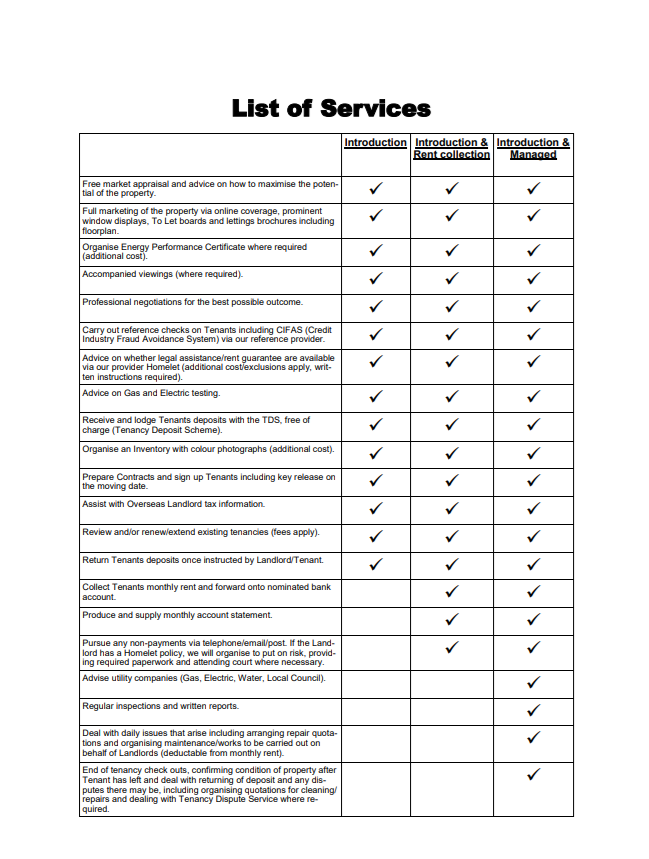
Seven members of staff within our dedicated property management department plus our experienced branch staff to assist you throughout the process.
- Full internet coverage 24 hours a day 365 days a year across all major web sites including Rightmove, OnTheMarket.com and Churchandhawes.com.
- Full members of the Property Ombudsman Scheme, ARLA Propertymark and the Tenancy Deposit Scheme.
- Your property will be available across our branch network with window display offering maximum coverage for your property.
- Floorplans as standard.
- Inventories supplied (additional cost) highly recommended.
- Energy Performance Certificates (additional cost).
- Local Multi office Network offering maximum access to Tenants.
- Distinctive “TO LET” boards placed at the property free of charge.
- Latest lettings software technology.
- Accompanied viewings when required.
- Feedback on all viewings within 24 hours (where possible).
- Please ask about the many products we can offer regarding legal assistance and rent guarantee warranties.
Remember it is Your Property
Before deciding to let a property, please remember it is important to protect your
investment by maintaining the property and ensuring any issues are resolved.
It is prudent to give yourself a sinking fund, so that if any issues do arise the funds
are available.
If a Tenant feels that you are a responsible Landlord they are more likely to stay in
the property for a longer period, this again is financially beneficial as the rent should
keep coming in, without any expensive void periods. (i.e. when the property is empty
between tenancies).
Remember it goes without saying that the better presented a property is, the quicker
it will let and also the more suitable Tenant you are likely attract. Please clean
ovens, fridges and carpets etc.
1. Generally
The normal agreement used for the letting of residential property is what is called an
Assured Shorthold Tenancy. The object of this is to give you, the Landlord, a
guaranteed right to recover possession. You should not have Sitting Tenant
problems providing the correct procedures are followed.
In rare circumstances there are certain tenancies for which an Assured Shorthold
Tenancy cannot be used. For example, if the Tenant is a company or holiday
letting, or if rent per annum exceeds £100,000, or if the property has been converted
into flats and the Landlord lives in one of these properties. These types of tenancy
will require a licence which is outside of Church & Hawes knowledge and expertise.
A licence will need to be drawn up by your solicitor. Church & Hawes recommends
that the Landlord takes advice from their Solicitor so that the Landlord fully
understands the differences between an Assured Shorthold Tenancy and a
Licensed tenancy. (If required Church & Hawes can recommend a local solicitor,
however additional fees will apply.)
The Tenant must be occupying the property as their principal home.
The rent you decide on is usually paid monthly in advance. Tenants do have
statutory rights to ask for this to be reviewed. The chances of this happening are
fairly remote but you must appreciate there is a small risk in this respect.
The Tenant has a right to claim a minimum tenancy of six months. A longer period
can be agreed. Tenancies for twelve months or longer are also quite normal.
*Local planning authority consent is required especially where the property is an
annexe or similar.
2. Credit / Reference checks
Reference checks that are completed by our reference agency Homelet.
We help take the risk out of property rental through our reference providers award
-winning service and comprehensive referencing. Our provider Homelet’s
specialist referencing department complete over 500,000 references a year and
perform a multitude of checks to provide an objective assessment of potential
Tenants. These checks include:
Adverse Credit History – Bankruptcy, CCJs and Court Decrees (Satisfied or not
satisfied).
Undisclosed addresses – Any previous names and addresses which the Tenant
has not disclosed on their application which are linked to their current and most
recent homes are also checked for adverse credit history.
Electoral roll check – An applicant’s presence on an electoral roll provides a
form of proof of address.
Bank validation – Confirms whether the bank details provided are for a genuine
account.
CIFAS (Credit Industry Fraud Avoidance System) – A fraud prevention service
that enables organisations to exchange information about potential fraud that it
has experienced. Individual’s details can be logged so other members can have
an awareness of suspicions against them. Innocent victims of fraud are also
logged on to CIFAS to protect them from further fraud.
Homelet Default Database – This is a record of any Tenants that we have had
to deal with for non-payment of rent or involvement in our Rent Protection claims
in the past.
Consistency of application cross check – If Homelet have referenced the
same applicant within the last 30 days we run some additional checks to ensure
that the information has been changed to pass through the referencing.
IP matching – This checks whether the same computer is being used to supply
references and a reference application.
Financial sanctions – A check which identifies whether an applicant is
registered on any of the Government Asset Freezing lists.
Financial Reference – The applicants employer, chartered accountants or
pension administrator is contacted to check whether the prospective Tenant is
being paid the same amount that has been declared on their application, as well
as checking whether there is any reason their circumstances may change in the
future.
Landlord reference – The applicant’s current Landlord or Letting Agent are
contacted to ask them whether the tenancy has been conducted in a satisfactory
manner.
Please note that even though these comprehensive checks are carried out
by our reference provider, nothing can be guaranteed, We would
recommend the products offered by Homelet to protect you further are
seriously considered.
Under some circumstances a Guarantor may be required. This is when the
Tenant fails to meet the credit company’s criteria and are asked to provide a
Guarantor so that in the event of being unable to pay the rent, the Guarantor
steps in and is requested to make the rental payments on their behalf.
If this is the case, then references for both Tenant and Guarantor will be supplied
to the Landlord for their approval.
3 Rental Warranties & Legal Assistance
Unfortunately life throws up unexpected circumstances and disappointments
through redundancy, ill health, pandemic, accident or divorce which can leave you
exposed to non-payment of rent or Tenant refusing to leave. This of course can be
expensive and time consuming if you as the Landlord have not protected yourself
with Rent Guarantee/Legal Assistance Cover.
Let only Landlords will be charged £80 plus VAT (£96) for legal assistance. This is
free to managed Landlords providing tenants pass references and meet Homelet
(our reference agency) criteria. This will then provide one year’s legal cover. Please
contact Church & Hawes regarding rent guarantee products that are/may be
available.
4 Permission To Let
Consent may be required to Let your property from one or all of the following
parties:
*Mortgage Company
*Insurance Company
*Any joint owner or superior Landlord.
Any Landlord should seek permission from their mortgage company. Without
permission your lender could foreclose the loan and issue proceedings against any
breach of terms regarding the mortgage.
Check your insurance and ensure letting is permitted and ensure that buildings
insurance is still in place.
Church & Hawes can put you in touch with a company that specialise in buildings
and contents cover, where required, as other insurers may not provide Landlords
cover.
If the property is Leasehold then the Freeholder and/or Management Company
must be advised, as some blocks of apartments do not allow properties to be let.
If you have a mortgage, it is necessary to obtain consent from the mortgagee
before a Tenancy Agreement is entered into. Most banks and building societies
provide a list of conditions which must be met in order to secure their consent.
These conditions are usually a formality and are not onerous. A charge is often
made by the mortgagee to cover administration costs.
Once you have made the initial approach, we shall be pleased to liaise with the
mortgagee to comply with their specific requirements.
The majority of mortgagees require the property to be professionally managed and
may require either a draft or a copy of the Tenancy Agreement.
5 Furnished Or Unfurnished
The majority of properties are let unfurnished, as the majority of Tenants have their
own furnishings etc. The larger and more expensive properties may require certain
appliances/items to be included as standard.
If you decide to let your property furnished/part furnished, with any items including
the list below, then you must consider your responsibility and liability regarding
repair or replacement where necessary.
*Oven, Hob/Freestanding cooker/Fridge/Freezer
*Washer dryer/Washing machine/Dishwasher
*Blinds/Curtains and carpets in good clean condition
5.1 Furniture Safety
Modern upholstered furniture, which complies with fire safety tests, has a label on it
(except beds and mattress) confirming that this is the case. Second hand furniture
especially that manufactured before 1988, does not comply. Non-complying
furniture must not be supplied in rented accommodation and should be removed
before letting out.
These regulations apply to all upholstered furniture with loose or fitted covers, beds,
headboards, pillows, cushions, children’s furniture and garden furniture.
6 Tenancy Agreement
Landlord and Tenant must exchange a legally binding Tenancy Agreement for the
specified term.
Included in our letting service, we provide a suitable Tenancy Agreement complying,
where appropriate, with any specific requirements of your mortgage.
You must serve the Section 21 notice a minimum of TWO CLEAR MONTHS before
you require the property back from a rent due date. The tenant is required to give
one month’s notice from the rent due date to end the tenancy (although this is not
enforceable) if the tenancy becomes periodic (i.e. month to month) then the above
notice periods still apply.
At least three months before the end of any tenancy you should review your
position and decide.
· Do you wish the Tenant to vacate at the end of the current tenancy period?
· Do you want to negotiate a new fixed term tenancy at the same or a new rent?
· (Please be advised that any rent increases can only be made annually) and
not within the first twelve months of the tenancy start date.
· Are you happy for the Tenant to remain at the property at the existing rent
continuing on a month to month basis (known as a periodic tenancy).
7 Inventory
A full inventory of the property, furniture, equipment and also Landlord’s fittings and
their condition is necessary and should be attached to and form part of the Tenancy
Agreement.
If you wish to prepare your own, this must be received in good time before the
commencement of the tenancy and include date marked photographs where
possible. Alternatively, we shall be pleased to organise the inventory on your
behalf; however, there is an extra charge for this service. Please see our Terms of
Business.
Church and Hawes strongly advise that a thorough Inventory is prepared and
is signed by the incoming Tenant at the commencement of the tenancy as
without it, it will prove extremely difficult if not impossible to recover any
damages out of the security deposit. Any disputes that cannot be resolved
will be referred to the Tenancy Deposit Scheme – Church & Hawes are
members of the Tenancy Dispute Service.
It is important to understand that by not professionally having a thorough
inventory carried out it may prejudice any future possible claims in the event
of it being heard by an independent case examiner of the Tenancy Deposit
Scheme.
Minor items of little value are not usually included in the inventory nor consumables
such as cleaning materials.
Any items stored on the premises, for example in
the loft, will not be included in the inventory and will not, therefore, be
checked at any time. Similarly, we can take no responsibility for items stored
in lofts etc, and which are left at your own risk.
8 Protected Assured Shorthold Tenancy Deposits
Managed Clients
Please note that if Church & Hawes ARE MANAGING the property on your behalf,
our external check out company will provide a report on the condition and also take
meter readings. This will then be given to you to asses and for you to advise of any
deductions that you feel are necessary. Church & Hawes will organise any quotes
for cleaning/repairs where necessary and will liaise with the tenants for a mutual
agreement. The deposit will then be allocated accordingly or if no agreement can be
reached will be given to the “The Tenancy Deposit Scheme” TDS to adjudicate.
Let Only Clients
If you are a LET ONLY CLIENT, the check out will need to be carried out by
yourself and you will need to liaise directly with your tenant regarding any
deductions etc. If we are holding the deposit, both you and the tenant will need to
confirm in writing to Church & Hawes your agreement. For example 100% of the
deposit can be returned to the tenant or 25% to landlord & 75% to tenant etc etc.;
(SEE FURTHER INFORMATION BELOW REGARDING THE TDS)
8.1 Definitions
“Calendar Day” or “day” means any day of the year, including Saturdays, Sundays
and bank holidays.
“Relevant Person” means person who paid the deposit or any part of it on behalf of a
Tenant.
“Stakeholder” means a person or body who holds the deposit at any time from the
moment it has been paid by the Tenant until its allocation has been agreed by the
parties to the Tenancy Agreement, determined by the ADR process, or ordered by the
court.
“ Scheme” means an authorised Tenancy Deposit Protection Scheme (set up in
accordance with the Housing Act 2004 and operated under a service concession
agreement with the Government) administered by The Dispute Service Limited.
“Statutory Time Limit” means the time limit set out in the Housing Act 2004 (as
amended) in which the initial requirements of the Scheme must be met, and prescribed
information must be provided to the Tenant and any Relevant Person.
“Working Day” means a day that is not a Saturday or Sunday, nor any day that is a
bank holiday under the Banking and Financial Dealings Act 1971 or any customary or
public holiday in England and Wales.
8.2 Assured Shorthold Tenancy Deposits
If a Tenant pays a deposit in connection with an Assured Shorthold Tenancy (“AST”)
the deposit must, from the moment it is received, be dealt with in accordance with a
government-authorised Tenancy Deposit Protection Scheme.
The Landlord must give the Tenant and any Relevant Person ‘prescribed information’
about the deposit and comply with the initial requirements of an authorised scheme
within the Statutory Time Limit.
We are a member of the Tenancy Deposit Scheme, which is a government-authorised
Tenancy Deposit Protection Scheme, administered by:
The Dispute Service Limited
PO BOX 1255
Hemel Hempstead
HP1 9GN
Phone: 0300 037 1000
Web: www.tenancydepositscheme.com
Email: deposits@tenancydepositscheme.com
If we receive an AST deposit on your behalf, we will serve the prescribed information
and comply with the initial requirements of the Tenancy Deposit Scheme on your
behalf, unless you give us prior written instructions to the contrary before we receive
the deposit.
If you do not want us to protect the deposit on your behalf, it will be your responsibility
to protect it as required by law. A valid notice seeking possession under S21 of the
Housing Act 1988 cannot be served on a Tenant whose deposit is not protected. A
Tenant or any Relevant Person may apply through the courts for compensation
of at least the amount of the deposit, and up to three times the deposit, if the
Landlord (or someone acting on the Landlord’s behalf):
a) fails to give prescribed information within the Statutory Time Limit; or
b) fails to comply with the initial requirements of an authorised scheme within the
Statutory Time Limit; or
c) notifies the Tenant or Relevant Person that the deposit has been protected in a
scheme, but the Tenant or Relevant Person cannot obtain the scheme’s
confirmation that the deposit is protected.
If you do not give us written instructions that you want to make your own arrangements
for deposit protection, we will hold deposits relating to your properties under the terms
of the Tenancy Deposit Scheme. We must comply with the rules of the Scheme, and
this means that we will not be able to act on your instructions with regard to the deposit
if those instructions conflict with the Scheme rules.
The Scheme rules are available to view and download from
www.tenancydepositscheme.com. A very important point for you to bear in mind is that
we must hold the deposit as “Stakeholder”. This means that we can only pay money
from the deposit if:
a) both Landlord and Tenant (and any Relevant Person) agree; or
b) the court orders us to do so; or
c) the Tenancy Deposit Scheme directs us to do so.
8.3 During The Tenancy
We will hold the deposit as Stakeholder in our client account (separate from the money
we use to run our business).
Interest is not payable on any deposits.
If the Tenancy Deposit Scheme directs us to send the deposit to them, we must do that
within 10 days of receiving their direction. The Scheme will not normally direct us to
send them the deposit unless there is a dispute about how it is to be paid at the end of
the tenancy.
Where there is NO dispute about the deposit at the end of the tenancy.
At the end of an AST we will liaise with you to ascertain what (if any) deductions you
propose to make from the deposit, or have already agreed with the Tenant. [We will
help you to try and resolve any areas of dispute within a reasonable time obtaining quotations, estimates or arranging contractors on your behalf in accordance your instructions].
Once you and the Tenant have agreed how the deposit should be allocated, we will ask
you both to confirm your agreement in writing. We will then pay the deposit according
to what you have agreed, within 10 days of receiving confirmation of agreement from
you and the Tenant(s). We cannot pay until we have the Tenant’s agreement. If you
have joint Tenants, all of them must agree.
Where there IS a dispute about the deposit at the end of the tenancy
You must use reasonable efforts to reach a sensible resolution to the dispute as soon
as practicable after the tenancy ends.
A Tenant can ask us to repay the deposit at any time after the tenancy has ended. You
must agree to us releasing promptly any part of the deposit that does not need to be
held back to cover breaches of the Tenancy Agreement. We will take your instructions
at the time regarding the amount to be withheld.
If the Tenant asks us to repay some or all of the deposit, and we do not do so within 10
days from and including the date of the Tenant’s request, the Tenant can notify the
Tenancy Deposit Scheme. The Scheme will then direct us to pay the disputed amount
to the Scheme. We have 10 days, from and including the date we receive the
Scheme’s direction, to send in the money.
If we protect a deposit with the Scheme on your behalf, you hereby authorise us to
pay to the Scheme as much of the deposit as the Scheme requires us to send.
We will contact you to keep you informed, but we will not need to seek your further authority to send the money to the Scheme.
The Tenancy Deposit Scheme will review the Tenant’s claim and decide whether it is
suitable for independent alternative dispute resolution. Usually, this will take the form of
adjudication, but it may involve assisted negotiation or mediation. “Alternative” in this
context means an alternative to court proceedings. It is intended to be a faster and
more cost-effective way of resolving disputes. The Scheme does not make a charge
to Landlords or Tenants for using the Alternative Dispute Resolution Service if it relates
to an AST.
If the Tenant’s claim is referred for alternative dispute resolution, we and you will be
invited to accept or contest the claim. You must notify the Scheme whether you agree
to submit the dispute for alternative dispute resolution within 10 working days from (but
not including) the date of the Scheme’s communication to you. If you do not respond
to the Scheme by the deadline, you will be treated as having given your consent
to alternative dispute resolution.
Agents and Landlords are permitted to refer a dispute about a deposit to the Tenancy
Deposit Scheme. If you or we refer a deposit dispute to the Scheme, the Scheme will
contact the Tenant to confirm whether the Tenant will agree to alternative dispute
resolution. If there are joint Tenants, all the joint Tenants must agree. A Tenant who
does not reply to the Scheme is NOT deemed to consent to alternative dispute
resolution. If the Tenant (or all joint Tenants) do not agree to alternative dispute
resolution, and do not agree to the deposit deduction(s) you claim, you will need
to begin court proceedings if you wish to pursue your claim.
If the parties agree to adjudication, the adjudicator’s decision is final and there is no
right of appeal. Further information about adjudication is available free to download
from www.tenancydepositscheme.com.
The Tenancy Deposit Scheme will pay the disputed amount to the person(s) entitled
within 10 days beginning on the date the Scheme receives notice of (a) the
adjudicator’s decision or (b) an order from the court that has become final or (c) an
agreement being reached between you and the Tenant(s).
If you order any work to be done at the property before a dispute has been resolved,
you do so at your own risk. There is no guarantee, if you incur expense, that a dispute
will ultimately be resolved in your favour.
8.4 Consent To Use Personal Information
When you agree to use our services, you agree that we may use information you give
us, including information about yourself, for the purposes of performing our obligations
to you.
You agree that we may supply such information as is reasonably required to the
Scheme. You agree that the Scheme, or the government department responsible for
the Scheme, may contact you from time to time to ask you to participate in surveys. If
at any time you do not wish the Scheme to contact you for that purpose, you should
write to the Scheme as explained in the Scheme Leaflet (see
www.tenancydepositscheme.com).
8.5 Our Duty To Provide Correct And Complete Information
When you agree to use our services, you guarantee that all the information you provide
to us is complete and correct to the best of your knowledge and belief. You agree to
inform us immediately if it comes to your attention that any information was incorrect.
If we suffer any loss or incur any cost because information you have given us is or was
incomplete and/or incorrect, you agree to pay us the amount necessary to put us in the
position we would have been in if the information had been complete and correct. This
clause does not relieve us of our own obligation to use reasonable skill and care in
providing our services to you, or to take reasonable steps to keep our losses and costs
to a minimum once we realise that there is a problem.
8.6 Where The Tenancy Is Not An AST (i.e. Company Let)
The deposit does not have to be protected by law. However, the Tenancy Deposit
Scheme will make its independent Alternative Dispute Resolution Service available to
you as our client, because we are a member of the Scheme.
If a dispute arises you, we or the Tenant will contact the Scheme. Then:
a) the Scheme will propose what they consider to be the most effective way of
resolving the dispute (assisted negotiation, mediation, adjudication or arbitration);
b) you, we and the Tenants must consent in writing to the proposed method if we all
want to proceed (if we don’t, the options are to negotiate or litigate);
c) the parties will have to pay a fee of £500 + VAT (or such other minimum fee as
the Scheme may set from time to time) or 10% of the deposit plus VAT,
whichever is the larger amount.
The Scheme will not start the dispute resolution process until all parties have agreed in
writing to use the Scheme and paid the applicable fee and the disputed deposit to the
Scheme.
8.7 If you instruct us that you do not want us to protect an AST deposit
If the deposit relates to an AST and you decide to hold the deposit yourself, you must
tell us before the Tenancy Agreement is signed. (we require a minimum of 7 working
days notice).
We will notify you of the date we receive the deposit and aim to transfer the deposit to
you within 5 days of receiving it. By law you must then register the deposit with an
authorised Tenancy Deposit Protection Scheme within 30 days of the date we received
it. You must also give the Tenant(s) and any Relevant Person ‘prescribed information’
about the deposit. If you do not do both these things within 30 days of us receiving the
deposit, the Tenant or any Relevant Person can take legal action against you. The
court can make an order stating that you must pay the deposit back to the Tenant, or
lodge it with the custodial Scheme run by the Deposit Protection Service. The court will
then also order you to pay compensation to the Tenant of between one and three times
the amount of the deposit.
By law, you may not serve a notice seeking possession under Section 21 of the
Housing Act 1988 notice until you have served the prescribed information. If you have
not complied with the initial requirements of an authorised Tenancy Deposit Protection
Scheme, you cannot serve a S21 notice until you have returned the deposit (or the
agreed balance of it) to the Tenant or court proceedings relating to the return of the
deposit have been disposed of.
If you instruct us that you do not want us to protect an AST deposit, we shall not be
liable to you for any loss suffered or cost incurred if you fail to comply with your
obligations to protect the deposit and give prescribed information. You must pay us for
any loss or inconvenience suffered or cost incurred by us if you fail to comply with those
obligations. This clause will not apply if the reason for your failure is because we failed
to send you the deposit within 20 days of receiving it.
8.8 Joint Landlords
If there is more than one Landlord, any of you will be able to participate in alternative
dispute resolution. TDS does not accept liability to any one or more joint Landlords for
acting on the instructions of any other joint Landlord. TDS does not accept directions
from joint Landlords to deal only with instructions agreed unanimously by joint
landlords. If you want all decisions to be made jointly, this is something that should be
agreed between the Landlords. It will then be a matter for the Landlords to resolve
among themselves if one or more of them have not complied with that agreement.
9 Accounting for managed properties
We account to you monthly to your UK or overseas address remitting monies to
your UK bank account. This can be carried out by bank transfer (we will require
your account details for this), It is regretted we are unable to make cash payments
to clients. We can also send your monthly account by email (please supply your
email address) particularly useful for clients living abroad.
10 Income Tax
UK Owners
Rents received are subject to UK income as unearned income. Where you remain
resident in the UK it is your responsibility to declare any income received to the
Inland Revenue.
Overseas Owners
Rents received are subject to UK income tax as unearned income. When we
receive the rents on your behalf, we are responsible for payment of any tax due by
deduction from the rents received, in accordance with the Provisions of the Taxes
Management Act 1970. Accordingly, out of the rents received, a proportion of the
rent monies are retained until your liability has been agreed with the Inland
Revenue.
As soon as your liability has been quantified, any excess reserved will be remitted to
your UK bank account.
If you have any queries on the extent of your liability you should contact your Tax
Office.
The needs of the overseas Landlord are best met by obtaining an Exemption
Certificate from the Inland Revenue. The certificate contains an approval number
and the date from which we are not required to withhold tax. If the Tax Exemption
Certificate is not received. by Church & Hawes, we must make quarterly payments
to the Inland Revenue.
11 Repairs & Maintenance
Our standard Tenancy Agreement provides that the Tenant keeps in good repair
and condition the interior of the property and also repairs and replaces damaged
furniture and equipment if this is caused by the Tenants negligence. Any items such
as white goods, furniture etc that is left in the property will be your responsibility as
the Landlord to repair or replace if this is caused by breakdown or general wear and
tear. By statute you as Landlord must be responsible for the main repairs of your
property and this liability cannot be passed to the Tenant. In general terms your
liability will be as follows:-
· To keep in repair the structure and exterior of the property including the drains,
gutters and external pipes.
· To keep in repair and proper working order the installations in the property for
the supply of water, gas, electricity, oil and for sanitation including basins,
sinks, baths and W.C.’s.
· To keep in repair and good working order installations in the property for
heating water and supply central heating (or storage heaters if appropriate).
When arranging emergency repairs on your behalf, we reserve the right to carry out
repairs if we are unable to contact you within 48 hours or if emergency repairs
immediately where required on your behalf. We normally operate within a limit of
£350.00 except where we consider that to delay repairs whilst awaiting your
instructions would prejudice or result in further damage to your property. Please
note when Church & Hawes act as Managing Agents we will endeavour to rectify
any situation as soon as is possible. Please be advised that situations which arise
at weekends especially or evenings (ie. boiler breakdown) will be dealt with as soon
as possible but cannot guarantee when an engineer can visit the property although
we would endeavour to organize this as quickly as possible.
Where appropriate, competitive estimates are obtained for consideration.
We recommend that all Landlords arrange regular maintenance of central heating
and alarm systems. You will need to explain to the Tenant and ourselves fully how
any alarm system works.
12 Services and Outgoings
Whilst we will notify water, gas, electricity, cable and telephone suppliers of the
change of occupancy for managed clients only. We must stress that they are not
obliged to take instructions from Agents to change the service into the Tenants
name. It is therefore advisable for you to make arrangements with them direct.
Introduction only clients must notify the utility companies themselves.
To ensure that you do not become liable for the use of these services whilst the
Tenant is in occupation, we require that the Tenant applies for connection in his own
name. If you do not terminate agreements for supply, then the Tenant may be able
to use the connection without taking over the liability.
If your property is equipped with oil fired central heating, then we advise to leave the
minimum safe amount in the tank to cover the oil requirements of the property whilst
the property is empty, thus avoiding the risk of the oil not being replenished by the
Tenant at the end of the tenancy. If this is not possible then a note of the fuel level
should be supplied to us by yourself at the commencement of the tenancy and the
Tenant will be expected to make good any shortfall in the level on expiry of the
tenancy. It is not always possible for Church & Hawes to obtain an oil level reading
at the checkout.
Sometimes with leasehold properties water rates are included within service and
maintenance charges. If so no action is required.
For managed clients we will also notify the Local Authorities of the change of
occupancy so that they can amend their Council Tax records appropriately and
prepare a revised account. Introduction only clients will need to deal with this direct.
With regards to mail we regret that we cannot take responsibility for the forwarding
of your mail and you should therefore arrange with the Royal Mail to re-direct your
correspondence.
13 Insurance
It is essential that your Insurers, both of the building and its contents, are notified of
the letting or they may impose restrictions on any claim or indeed, refuse to cover a
particular event since their risk is altered where the property is let (not advising of a
material fact i.e. being rented may make your insurance void).
Please consult your Broker or your Insurers if you have any query in this connection.
You are advised to ensure that your Property Owners Liability is adequate and also
any other insurance as required, again your Broker or Insurers should be able to
advise.
We are pleased to advise you that we have insurance companies which specialise
in rental property insurance. Please ask for further details.
14 Safety Regulations
You must remember that there are regulations as a Landlord that you must comply
with covering the following:
Portable electrical equipment and plugs.
Furniture and furnishings.
Gas cookers and other gas appliances.
Smoke and carbon monoxide detectors.
Electrical safety standards in the private rented sector.
14.1. Electrical Safety
Electrical Safety Standards in the Private Rented Sector Regulations 2020”
An electrical installation condition report (EICR) is now required by law.
Key Points:
· Landlords must ensure that the electrical safety standards defined by the IET
Wiring Regulations 18th edition, are met during any periods when the
property is tenanted.
· Applies to all NEW tenancies from 1 July 2020 and EXISTING tenancies from
1 April 2021.
· New tenancies include Landlords who “intend” to rent a property i.e. before a
tenancy starts.
· The electrical installation must be inspected and tested at regular intervals of
no more than 5 years or less, if the most recent report specifies less than 5
years.
· The Landlord must obtain a copy of that report and provide a copy of that
report to each existing tenant within 28 days of the date of inspection and
test.
· The Landlord must provide a copy of the most recent report to:
1. Any new tenant before they occupy the premises.
2. Any prospective tenant within 28 days of receiving a written request.
· The Landlord must retain a copy of that report until the next inspection is due.
· If the report requires further investigation or urgent remedial action are
required (i.e. Code 2 or Code 1 items) to ensure the installation complies with
BS7671, the Landlord must ensure the works are carried out by a qualified
person in 28 days or less of the report date.
NB : The Regulations do not stipulate remedial works are completed before
tenants move in – just that an installation is tested and urgent remedial works
completed in 28 days. Assuming no Code 1 items, this allows new tenancies
to commence before remedial works are complete.
· Landlords must ensure that for any investigation or remedial works as per (8)
they receive written confirmation
1. That the works have been carried out and the electrical safety standards are
met.
2. Supply a copy of that report to each tenant in 28 days of completion of the
works.
· Where a local housing authority (LHA) has reasonable grounds to believe a
Landlord is in breach of their duties, the LHA must within 21 days, serve a remedial
notice on the Landlord. A Landlord can make representations to the LHA and this
suspends the remedial notice until the LHA considers and de4cides upon those
representations.
· A Landlord is not in breach of their duty if they have taken all reasonable steps to
comply with that duty including tenant(s) preventing the Landlord from entering the
premises.
· Where a LHA believes that there is a breach of duty, they may arrange remedial
works with the consent of the tenant(s) and at the Landlords expense.
· LHA’s may impose a fine of up to £30,000 where they are satisfied beyond
reasonable doubt that a Landlord has breached their duty.
· Exclusions: Providers of social housing, where tenants live in Landlord’s home,
long leases (i.e. > 7 years), student halls of residence, hostels/refuges, care
homes, hospitals/hospices.
14.2 Electrical Equipment (safety) Regulations 1994
The above regulations came into force on January 9th 1995 and apply to all electrical
equipment. The regulations state that electrical equipment ‘shall be safe’ which means
that it complies with the definition within the Consumer Protection Act 1987 and extended
to comply with the regulations to mean that any risk includes: -
Death or injury to domestic animals. Damage to property. As well as the risk of
death or injury to a human.
As Landlord you must comply with the regulations as they clearly state that electrical
equipment being ‘hired out’ comes within this jurisdiction.
How to comply.
Ensure instructions booklets are supplied with all electrical equipment, including safety
instructions.
Safety checks to be carried out by an NICS qualified electrician, either annually or every
time a new person takes a tenancy of a property.
Church & Hawes will need to be supplied with proof of the safety check before tenancy
commences.
Church & Hawes can organize these important electrical checks for you, provided that we
receive instructions to do so.
Instruction booklets for appliances will also need to be given to Church & Hawes, if not at
the property, prior to commencement of the tenancy. If the booklets are unavailable,
written instructions can be sufficient. Also, if booklets do not contain safety instructions,
Church & Hawes may be able to supply instructions to most appliances at an additional
cost of £5.00 per appliance (we will require 14 days notice to prepare these).
Please be aware that it is essential that the relevant electrical reports are carried out
and that any safety recommendations are also carried out, whatever the cost,
because if anything did go wrong and these checks were not carried out or
recommendations implemented, your insurance may be void and the penalties are
as follows:-
· Three months imprisonment and/or £5,000 fine if there is risk of fire and/or an
animal is injured.
· Six months imprisonment and/or £5,000 fine if a human being is injured or
killed.
· The above can be increased to 12 months imprisonment (not to mention a
criminal record).
15 Gas Safety (Installation and Use) Regulations 1998
The regulations came into force on October 31st 1998, and it is law that all gas
fittings including boiler and pipes are checked and given a gas safety check by a
Gas Safe Registered plumber and any recommendations must be carried out before
a Tenant can move into the property. This inspection must be carried out annually.
Any unsafe appliances must be repaired or removed by a Gas Safe registered
engineer. Gas cookers in particular have specific gas safety requirements. Please
note this also applies to gas warm air heating systems and bottled gas appliances.
This certificate is an ANNUAL requirement.
(Church & Hawes will require two copies of the Landlords Gas Safety Record, one
for the Tenants and one for Church & Hawes). The tenancy cannot begin until this
document has been received. If you wish Church & Hawes to organise this for you
we will need fourteen days notice prior to the start of the intended tenancy.
FAILURE TO COMPLY WITH SAFETY REGULATIONS IS A CRIMINAL
OFFENCE AND CAN RESULT IN YOU BEING FINED HEAVILY/AND OR
IMPRISONED
16 Smoke & Carbon Monoxide Detectors
Landlords are required by LAW to ensure the safety of their Tenants by installing
SMOKE DETECTORS in all properties (ensuring there is a minimum requirement of
one smoke detector per floor) Landlords are also required to install CARBON
MONOXIDE DETECTORS where there is a GAS appliance, OIL appliance or
SOLID FUEL appliance, for example, near a boiler, cooker or gas fire, open and
solid fuel burners etc (one detector per appliance) Church & Hawes can organise
the installation of these detectors at a cost of £50 plus VAT per detector.
17 Legionnaires Disease
In order to comply with Health and Safety Executives Code of Practice, Landlords
are strongly advised to carry out a risk assessment at their premises prior to letting
especially if there are open water tanks, cooling systems or a swimming pool. We
request a copy of the written risk assessment is provided upon instruction. By
signing the Terms of Business which our Guide to Letting forms part of, the Landlord
acknowledges his responsibility for the safety of the Tenant at the premises and
confirms he has considered all the risks regarding Legionnaires Disease.
18 Special Requirements
Our Standard Tenancy Agreement provides that the Tenant must not keep pets or
animals without prior written consent. Other special conditions such as no smoking
and no children can be imposed if you wish. You must also remember that the more
rules and regulations that you impose the more likely some applicants may be
deterred from considering your property.
Please advise if pets will be considered as this can speed up finding a Tenant.
There may be restrictions and covenants with your deeds that the Tenant should
comply with. You should check with your solicitor if there are matters that should be
referred to Applicants.
19 Special Notes for Leasehold Properties
Please remember to let us have details of all rules and regulations that relate to your
Lease, in particular management of common parts.
Please remember that Ground Rent, Service and Maintenance Charges will be your
responsibility and must be paid by you promptly.
20. Inspections
f requested, Church & Hawes will organise the inventory to record its current
condition prior to the Tenancy Agreement being entered into (please see Terms of
Business for inventory charges on your property).
During the tenancy, where we are instructed on a full management service basis we
will normally carry out inspections of the property every four months.
At the end of the tenancy we will carry out a further inspection and if there is any
dispute concerning the condition of the property at the end of the tenancy this will be
referred to the Tenancy Dispute Service within the timescales stated (where
possible) or immediately be referred to a Chartered Surveyor if the tenancy was
created prior to the 6th April 2007, who will act as an arbitrator (Management
Service Only) and his fees will be shared equally between the Landlord and the
Tenant.
21 Terms of Business
Our Terms of Business which we asked you to sign to confirm your
instructions, should be read in conjunction with this preliminary guide to
letting, which forms part of our agreement.
22 Legal Aspects
Church & Hawes are not legal professionals, and in the event of a Tenant refusing
to leave, at the expiry of the Section 21 notice, or any other notices served, if you do
not have a suitable rent guarantee/legal assistance product you will need to employ
or seek legal advice from your solicitor.
Church & Hawes can advise of a solicitor who can help in these circumstances, you
will need to satisfy yourselves with their terms and conditions, before instructing.
UNDER NO CIRCUMSTANCES SHOULD YOU TAKE THE LAW INTO
YOUR OWN HANDS!
SEVERE FINANCIAL PENALTIES MAY APPLY FOR UNLAWFUL EVICTION.
23 Keys
Please ensure we receive a full set of the keys for each Tenant and one access set for
Church & Hawes well in advance of the proposed starting of the tenancy. On no
account should you give the keys directly to the proposed Tenant.
24 Unfair Terms in Tenancy Agreements
We have prepared our Agreements with the intention of complying with the Office of
Fair Trading Regulations. Generally the Courts decide whether any contract term is
unfair but the Office of Fair Trading may take its own enforcement action if any
provisions prove to be unfair. We do our best to comply with the regulations but cannot
provide any guarantee in this respect.
25 Illegal Activities
Unfortunately sometimes Tenants use a property for an illegal activity such as one
involving drugs. If we are aware of such activity, we will immediately report it to the
Landlord who should then take appropriate action such as reporting the activity to the
Police and asking their solicitor to pursue the matter if necessary. We will not become
directly involved with problems of this nature which we consider to be outside our letting
and management services.
26 Energy Performance Certificates
It is a legal requirement that all Tenants are to be provided with an Energy Performance
Certificate. An Energy Performance Certificate is valid for ten years. Church & Hawes
can organise this certificate for you at what we believe to be a very competitive price. If
however you decide to organise this yourself we will need it in advance of marketing
your property. Please see Section 31 regarding new MEES legislation.
27 Draining Down of Properties
Church & Hawes recommend that all empty properties are drained down by a qualified
plumber, especially during cold periods. If you would like Church & Hawes to organise a
quote for this, please do not hesitate to contact our Lettings Administration Department
or your local branch.
28 Payments in Advance
In some instances it is possible that a Tenant would pay the full rental term in advance.
If this should happen Church & Hawes would retain £350.00 as per clause 2 of the
Additional Terms for Management Services on Church & Hawes Terms of Business.
This is for any minor repairs, especially boiler breakdowns. If Church & Hawes had
cause to use part of or all of this amount then we would ask you as the Landlord to reestablish the balance to £350.00. Upon the tenancy finishing the £350.00 or balance
would be credited to yourself. Please note legal assistance products are not available
when rent is received in advance.
As you can see, we at Church and Hawes take looking after your property very
seriously.
Instruct Church and Hawes and we will look after you.
RENTERS RIGHTS ACT CHANGES FROM:
- RED 1ST MAY 2026, BLUE LATE 2026/27
RRA 1. Offers in Excess of Marketing Price/Rental Bidding *
Since the Renters Rights Act became law it is illegal to accept offers in excess of the
marketing price. (Agents and landlords who ignore this would be unable to serve notices and also open to fines of up to £7,000 for landlords or anyone acting directly or indirectly on their behalf)
Landlords and Agents can receive multiple civil penalties for continued and repeat
breaches.
RRA 2. Pets *
Tenants will have the right to request a pet in their rental property, and landlords cannot unreasonably deny this request. It is also important to understand
that a refusal must be based on location specific reasons, (I do not like pets are
had a bad experience in the past are not considered by the new Law to be valid
reasons).
Please also note under the “Equality Act” permission must be granted for service animals for disabled tenants. If you refuse permission for a pet, the tenant
can take their request to the tribunal for independent adjudication. Church &
Hawes can accept no liability for any decision made by the tribunal .
RRA 3. Payments in Advance *
Under the (Renters Rights Act 25), it is illegal for Church & Hawes or Landlords to take
advanced rental payments. This means that only the first months rent and the five
weeks security deposit (including the holding deposit are allowed) The fines for
breaches of the above are £7,000 for the first offence and £30,000 for each subsequent breach. This means we are unable to take any payments above the permitted
amounts. All rental payments will have to be paid per calendar month.
RRA 4. Discrimination *
Since the Renters Rights Act became Law in 2025, it is illegal to discriminate
against tenants receiving benefit and tenants with children or pets. Church &
Hawes also adhere to the “ Discrimination Act" in the UK which is the Equality
Act 2010.
RRA 5. Rent Repayment Orders *
The Act will extend rent repayment orders (RRO) to the offences of knowingly
or recklessly misusing a possession ground, breach of restriction on letting or
marketing a dwelling-house, continued tenancy reform breach after imposition
of a financial penalty, continued breach of landlord redress scheme regulations,
imposition of a financial penalty, providing false information on the PRS Database when purporting to comply with PRS
Database and continued failure to register with the PRS Database after the imposition of a financial penalty. Along with failure to obtain a license where required.
RRA 6. Tenancy Agreement/Notice Periods/Re-Marketing *
Tenancies are now on a rolling periodic month to month basis. (Fixed term
tenancies have been abolished) Tenant must exchange a legally binding Tenancy Agreement.
If you wish to move back into the property or wish to sell the property then a
Section 8 notice must be served to give notice (Section 21 notices are abolished), giving a minimum of FOUR CLEAR MONTHS notice from a rent due
date. The tenant has a protected tenancy for the first 12 months before they
can be evicted, notice can be served by the landlord after 8 months using
these grounds. There are many other grounds that can be used for different
reasons/timescales. A list of these can be provided on request.
The tenant is required to give TWO month’s notice from the rent due date to
end the tenancy and the tenant can serve this from the date the tenancy
starts. It is recommended that at least SIX months before you require the property back you should review your position, so as to allow sufficient time for the
Section 8 notice to be served. Due to the complex nature and legal pitfalls of
serving a Section 8, this will need to be carried out by a solicitor. Church &
Hawes can recommend solicitors for the serving of a Section 8. (Solicitors will
charge for this service).
Please note that is a tenants does not leave at the expiry of the SECTION 8
this will involve going to court for eviction (Timescales unknown).
Once notice has been served on your tenant for reasons of selling the property or moving yourself or a family member into the property as a principle home,
you are not able to market the property for rent or use as a holiday let or under
a license for approx 16 months from when the notice was served
(Previously, as an example if a property did not sell, then a landlord would
have re-let the property, this is now against the legislation within the time
frames described). This leaves you with a potentially long void period. Flexibility on your sale price would be key in securing a buyer, particularly in a difficult
market. Otherwise this could result in a significant financial loss.
THINK CAREFULLY BEFORE SERVING NOTICE FOR THE REASON OF
SELLING. BEFORE SERVING NOTICE FOR THE REASON OF SELLING.
RRA 7. Increasing rents/Section 13 *
The rent you decide on is usually paid monthly in advance. This can only be
reviewed on an annual basis by serving a Section 13 notice with a minimum of
TWO months notice from a rent due date before the new rent can be liable, It
is advisable to start discussing a rental increase at least 3 months prior to the
allowable increase date. This must be a reasonable amount and based on the
local market rents and comparable evidence is recommended. If the tenant
disagrees, they can go to the tier 1 tribunal for adjudication.
A tribunal could take 6 months approx. meaning 6 months of no rent increase
and also no backdated rent is payable by the tenant, even if the tribunal finds
in the Landlords favour. It is important to increase by a sensible and affordable
amount to try and avoid this. The Tenancy will be on a month to month basis
with specific notice periods as described in the (Tenancy Agreement).
RRA 8. Landlords Database (DATES 2027)
The Government will be introducing a Landlords database in 2027 (exact date unknown), this
will be a mandatory requirement. We understand that certain information will need to be added
to the database and each property will receive a registration number (which will need to be displayed, when the property is marketed/has a tenant in situ). This will have to be completed by
the Landlord but if agents are required to upload this information (to be confirmed by the Government) then due to the increased level of work this requires, Church & Hawes will charge £25
plus vat per property (This is required by Law ) Local councils will be able to take enforcement
action against landlords who do not register. If a landlord lets or advertises a property without it
being on the database they can be issued with a civil penalty of up to £7,000. Continuous offences could result in fines of up to £40,000 or could face criminal prosecution. Landlords will
need to be registered in order to use certain possession grounds.
RRA 9. Decent Homes Standard (PHASE 3, DATES TBC)
The Decent Homes Standard will be introduced to the private rented sector as well as
social housing ensuring properties meet minimum quality requirements. The standard
requires properties to be in a reasonable state of repair, have modern facilities and services, be warm and energy-efficient, and meet the minimum safety standards . All Landlords in the private rented sector must take steps to ensure their property meets the
DHS standards. Local councils have powers to issue civil penalties of up to £7,000.
This is to ensure landlords proactively manage and maintain the safety and decency of
their properties.
RRA 10. Private Rented Landlord Ombudsmen (PHASE 2, 2028)
The Government is introducing a Private Rented Sector Landlord Ombudsmen Service
which all private landlords in England will with assured or regulated tenancies will be
required to join by law (This will be chargeable by the Ombudsmen). This is being introduced to provide a quick, fair, impartial and biding resolution for tenants complaints
about their landlord. This will bring tenant - landlord complaint resolution in line with established redress practices for tenants in social housing and consumers of property
agent services. We are awaiting timescales for when this will be operational.
RRA 11. Awaabs Law (PHASE 3, DATES TBC)
All private landlords will be required to meet “AWAABS LAW” requirements for example, on timescales for dealing with hazards such as damp and mould. Initial or minor
non-compliance will incur a civil penalty of up to £7,000 and serious persistent or repeat
non-compliance a civil penalty of up to £40,000 with the alternative of criminal prosecution.